|
 |
| |
|
| |
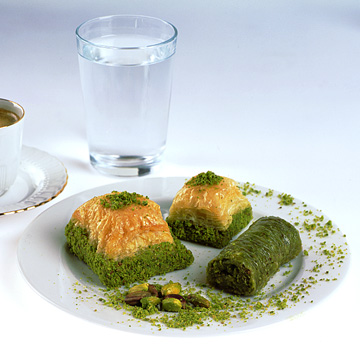
BAKLAVA | Why It is So Popular in Turkey

|
| |
One of the most valued desserts in the Middle East is baklava. This
special dessert is almost like a must in many of the Indian
cuisines, and is a mark of great food and also a delicacy in many
meals in turkey.
First prepared in the eighth century before Christ, it has gained
fame in all corners of the world, hence a key ingredient in many
foods in the Middle East.
With many chefs adopting and seeking for ways of preparing this
delicacy, it has become a major dessert in many meals in the big
hotels. Though a major dessert in many meals, baklava has one major
recipe known as pistachio hazelnut baklava, which makes the dessert
worthwhile.
The other ingredient that makes baklava possible is unsalted butter,
walnuts, sugar, mahlam and some dough.
Lemon juice is also a major delicacy when making baklava.
|
 |
|
| |
|
|
|
| |
The reason why many people love baklava as a dessert is
because it enhances the taste in any dish served with it,
and makes it possible for people to eat to their full. Any
meal served with baklava is both delicious and classy, hence
the reason why course meals with this dessert is both
expensive and classy, and is majorly taken by world class
business persons.
Even now, battle that rages over Baklava is of its
stuffing: What type of stuffing makes this the authentic
Baklava? Few insist that it is the pistachio Baklava,
whereas some insist it is walnuts Baklava.
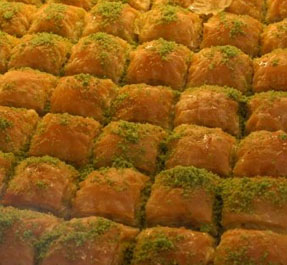
In case, you visit the brick n mortar specialty
store, which sells all types of the Baklava, then you are
thrown by mind boggling range of the sweet, and each one in
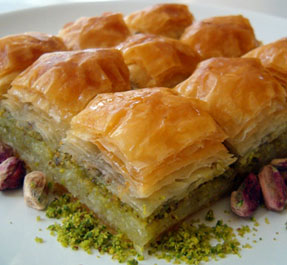
different avatar of the thin layered sheets with various
ingredients as well as set in various moulds. Everybody
who's had one taste of this knows that it is made of the
thin pastry puff of the wheat starch & sugar syrup.
While the whole world carries on hunger for the
Middle Eastern delicacy, now it has been made available
through stores online. Thus, to buy Baklava, you just need
to go on Net and buy online Baklava at the stores and place
your order. You just need to fill up some necessary
information and wait for this to get delivered in your
house. You can choose the traditional baklava with almonds,
pistachio baklava, cashew nuts and hazelnuts, pecan nuts,
chocolate, and any other nuts.
|
|
| |
|
|
|
| |
 |
 |
|
| |
|
|
|
| |
Etymology
The word baklava entered English from Turkish; It is
sometimes connected with the Arabic word for "bean", but Wehr's
dictionary lists them as unrelated; the Arabic name is doubtless a
borrowing from Turkish. Buell (1999) argues that the word "baklava"
may come from the Mongolian root baγla- 'to tie, wrap up, pile up'
composed with the Turkic verbal ending -v; baγla- itself in
Mongolian is a Turkic loanword. The name baklava is used in many
languages with minor phonetic variations.
|
|
|
<-Back
|
|
|
|
 |
|
 CITIES